


Hunterase ICV is indicated for patients with Hunter Syndrome as an enzyme replacement therapy administered intracerebroventricularly.
About
Hunterase ICV
What is
Hunterase ICV?
Hunterase ICV is indicated for patients with Hunter Syndrome (Mucopolysaccharidosis II, MPS II) as an
enzyme replacement therapy (ERT) administered intracerebroventricularly (ICV).

Reservoir Details
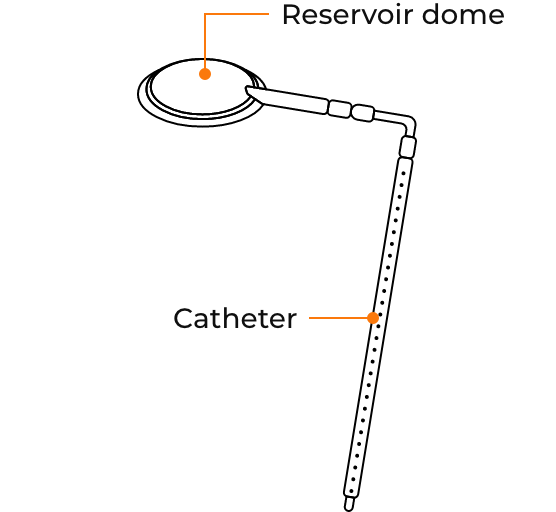
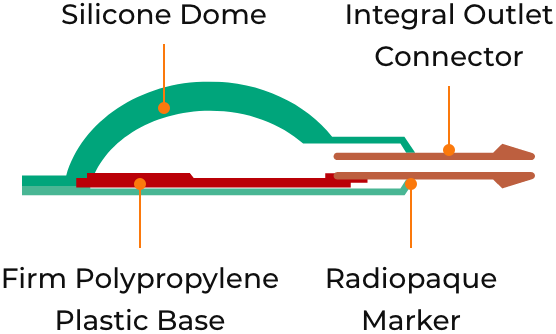

API
Idursulfase beta
Composition
(1 ml/vial)
15mg/mL of idursulfase beta in 150 mM of sodium chloride and 0.005% of polysorbate 20
Indication
Mucopolysaccharidosis type II Administration of Hunterase ICV Injection should be considered for patients with MPS II for which improvement of central nervous system symptoms is necessary.
Dosage and Administration
The usual dosage is 30mg of idursulfase beta (genetic recombination) administered intracerebroventricularly(ICV) once every 4 weeks. Administer Hunterase ICV inj. without dilution over at least 1 min.
Why Should CNS Symptoms Be Considered?

Non-neuronopathic (attenuated) type: Minimal CNS involvement
Common symptoms & signs
Developmental delay
Coarse face
Short stature
Skeletal abnormalities
(dysostosis multiplex)
Coarse face
Short stature
Skeletal abnormalities
(dysostosis multiplex)
Joint contracture
Hepatosplenomegaly
Upper airway obstruction
Valvular heart disease
Hepatosplenomegaly
Upper airway obstruction
Valvular heart disease
Neuronopathic (severe) type: CNS involvement
Neurobehavioral symptoms
Aggression
Hyperactivity
Sleep disturbances
Progressive neurological decline
Cognitive impairment
Hyperactivity
Sleep disturbances
Progressive neurological decline
Cognitive impairment
Urmet needs in
IV ERT-treated
patients

Symptoms of CNS involvement
Since conventional intravenous enzyme replacement therapy (ERT) does not reach the brain compartment, the abnormal accumulation of glycosaminoglycans in the brain can lead to degeneration of brain tissue and progressive decline in cognitive function. Cognitive development stops at the age of 3-4 years and regression starts at the age of 4-5 years.
Quality of Life
In the neuronopathic type of MPS II, developmental age can be significantly affected by the CNS involvement associated with the disorder. The patients experience intellectual disabilities and delays in speech and language development, which can affect their ability to learn, communicate, and function independently. In addition, the progressive nature of MPS II can lead to a decline in physical abilities over time, including difficulties with fine motor skills and mobility. These factors can further affect an individual's developmental age and overall quality of life.
Life Expectancy
The life expectancy of MPS II patients can depend on the severity of their condition. In severe cases of MPS II, life expectancy is significantly reduced and may be limited to the teenage years or early adulthood compared to a longer the life expectancy until the fifth or sixth decade in the attenuated type. Early diagnosis and intervention are indeed critical in prolonging life expectancy and improving the quality of life as well.Clinical Trials
Phase I/II
study with
5-year follow-up
Study Design
Multicenter, open-label, phase 1/2 clinical studyObjective
Evaluate efficacy and safety of ICV idursulfase-β (Hunterase ICV)Treatment
Dose escalation from 1 mg to 30 mg between weeks 0 and 24, followed by a fixed 30 mg dose. Administered intracerebroventricularly (ICV) once every 4 weeks using an implanted cerebrospinal fluid (CSF) reservoir. Intravenous (IV) idursulfase was continued throughout the study.Comparator
Historical control: 13 Japanese patients with neuronopathic MPS II treated with IV idursulfase onlyOutcome Measure
Developmental age (DA) data comparison
Heparan sulfate (HS) concentration in the cerebrospinal fluid (CSF).
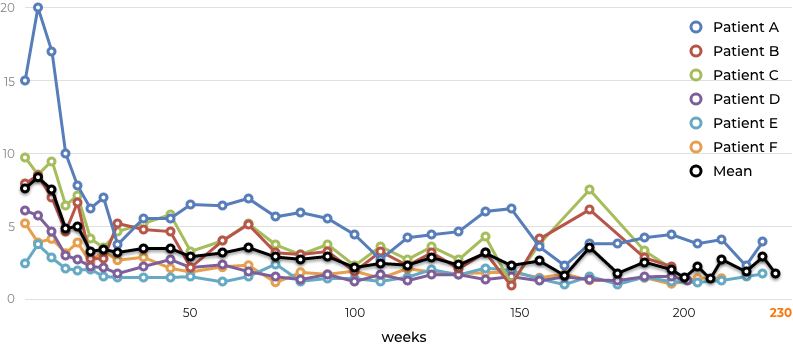
Change in CSF HS concentration (μg/mL)
Change in HS in the CSF of patients with MPS Il from the start of ICV idursulfase-β treatment up to week 228
Secondary endpoint
Developmental age (DA) determined by the Kyoto Scale of Psychological Development 2001 (KSPD) in the
following three areas: postural-motor, cognitive-adaptive and language-social
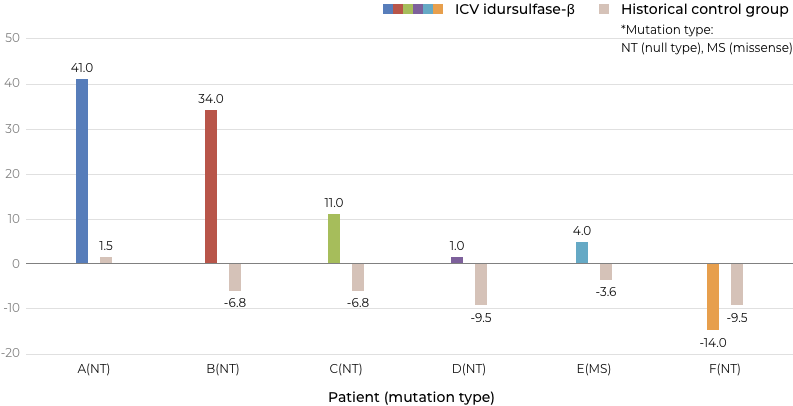
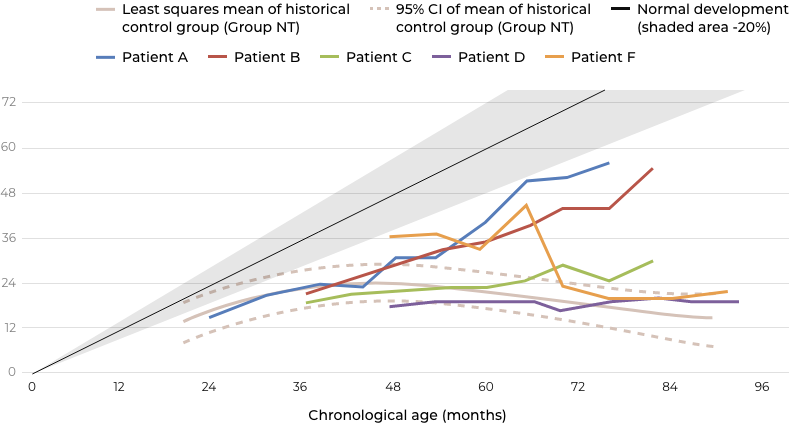
Change from screening period to final observation (range 196-220 weeks) in DA(all 3 areas) by KSPD (months)
Comparison with the historical control data in patients with MPS II
Change in KSPD DA from screening to final observation
Safety Information
PRECAUTIONS
Storage and
Shelf-life
They may depend on the approved conditions in individual countries.
- Store at 2 ºC to 8 ºC in a hermetic container.
- The shelf-life of this product is 24 months from the date of manufacture.
ENG Official Insert Paper


How to Use
Injection Procedure
- Implant a CSF reservoir under the patient’s scalp for i.c.v. administration.
- To prevent fluctuations in intraventricular pressure, collect CSF (2 ml) of the same volume with Hunterase ICV (usually 30 mg) to be injected in advance.
- Administer Hunterase ICV without dilution over at least 1 min.
Injection Schedule
Hunterase ICV is intracerebroventricularly administered once every 4 weeks (Hunterase ICV: 15 mg per
vial).
Please note that in the Phase I/II trial, intravenous administration of idursulfase (0.5 mg/kg/week) was also continued throughout the study; an interval of ≥24 hours was set between intravenous idursulfase and Hunterase ICV.


Please note that in the Phase I/II trial, intravenous administration of idursulfase (0.5 mg/kg/week) was also continued throughout the study; an interval of ≥24 hours was set between intravenous idursulfase and Hunterase ICV.
Example
IV : Once a week
ICV : Once a month
A minimum 24-hour interval is recommended between IV and ICV injections.
≥24 H
References
- Orphanet J Rare Dis. 2013;8:42
- Mol Ther Methods Clin Dev. 2021;21:67-75
- Mol Genet Metab. 2015;114(2):156-60
Contact us
For More Information,
Please
Contact Us.
Please
Contact Us.



Address
107 Ihyeon-ro 30-beongil, Giheung-gu, Yongin-si,
Gyeonggi-do Republic of Korea
Contact



© Hunterase ALL RIGHTS RESERVED
